Qwear
Role: Founder
Featured in: The Boston Globe, Huffington Post, Buzzfeed, Fashionista, Mashable, Tumblr
Visit Website
In 2011, I founded Qwear in Boston as an experiment in queer visibility, fashion, and survival. At the time, there were very few spaces online where LGBTQIA+ people — especially trans, nonbinary, femme, and gender-nonconforming people — could see themselves reflected through style outside mainstream fashion systems. I wanted to create a platform where queer people could document themselves on their own terms, experiment with gender expression, and feel less alone.
Over time, Qwear grew into one of the earliest online queer fashion platforms and a collaborative archive of LGBTQIA+ identity, aesthetics, and cultural history. Long before “fashion as self-care” became a mainstream conversation, I was explicitly framing queer fashion as healthcare: a tool for safety, self-recognition, confidence, and quality of life. For many queer and trans people, clothing is not superficial — it is deeply tied to survival.
Through Qwear, I worked with contributors, photographers, writers, designers, and activists from around the world to build a platform centered on identities often excluded from mainstream media. We published style editorials, interviews, essays, reader-submitted questions, fashion photography, and community storytelling, while also advocating for ethical fashion and broader representation across the industry.
Qwear also became the birthplace of Yasmin Benoit’s groundbreaking “This Is What Asexual Looks Like” campaign, which continues to shape conversations around asexual visibility and representation internationally.
Beyond publishing, Qwear hosts live events, exhibitions, and installations exploring the relationship between fashion, gender, power, and the body. Projects included Dismantle Me (2015), presented at Queer Fashion Week, Rainbow Fashion Week, and Boston Fashion Week; Femme Desire (2016) at the Institute of Contemporary Art Boston; and Legendary Children (2018) at the Boston University Art Galleries. More recent projects have included virtual fashion shows, gallery exhibitions, and print publishing initiatives.
In 2025, Qwear and my early collage work were featured in the Bloomsbury publication Queer and Trans Fashion Brands: Resistance and Revolution in the 21st Century, for which I also authored the foreword.
At its core, Qwear has always been about creating space: for experimentation, for complexity, for joy, and for people whose identities are often erased or misunderstood. It remains one of the most meaningful projects of my life.
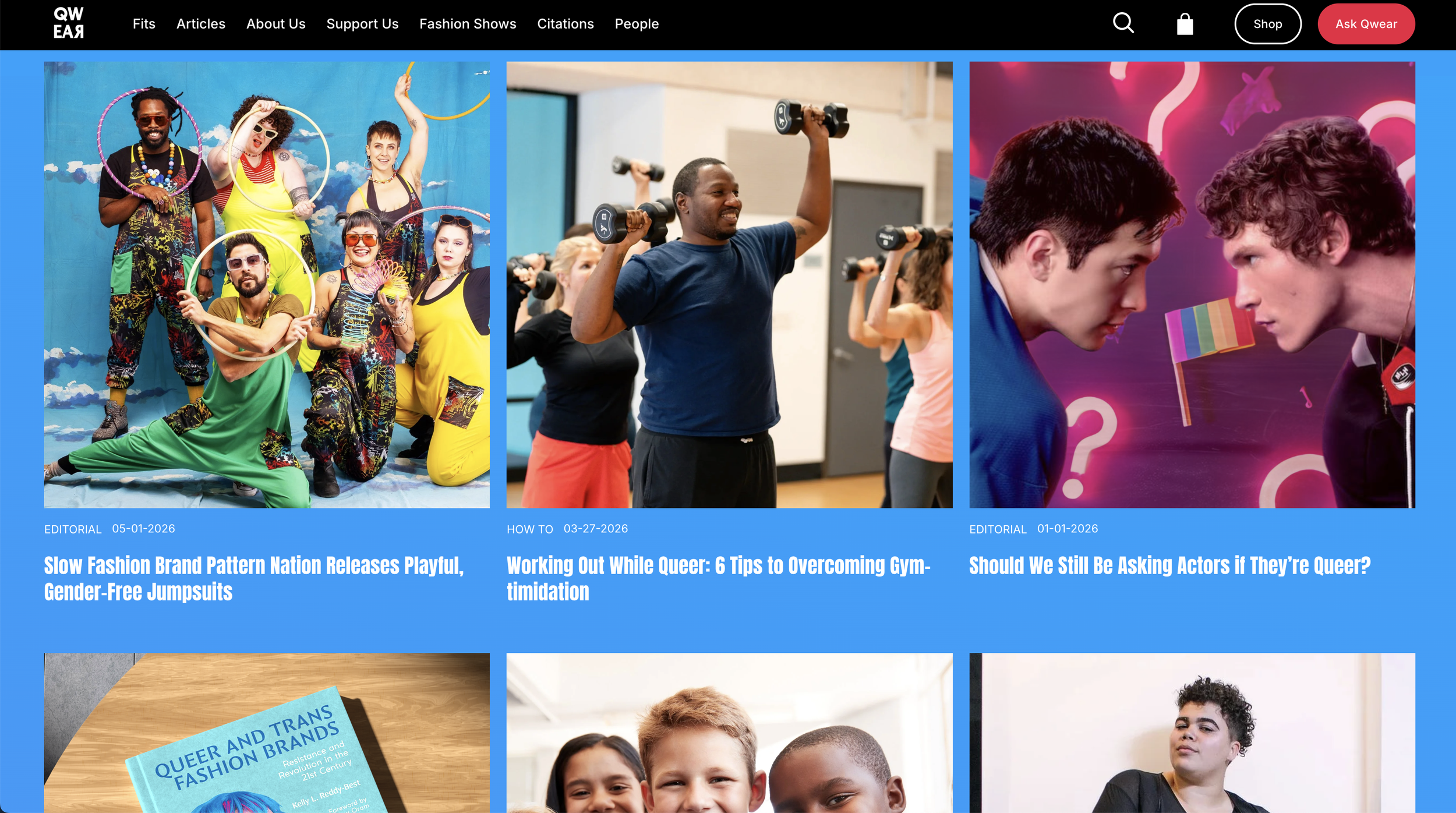
Qwear Homepage 5.15.26